

“When we write… it is easy to forget that the beginning is not the word, but the scream. Faced with the mutilation of human lives by capitalism, a scream of sadness, a scream of horror, a scream of anger, a scream of refusal: NO.”
John Holloway, Changing the World Without Taking Power
Whether Holloway had Edvard Munch’s The Scream in mind when writing this article’s epigraph, he does not divulge. Nevertheless, much like Holloway provocatively expresses in his radical inquiry into power, some have come to see The Scream as “the ultimate image of our political age”. To scream, according to Holloway, represents “a refusal to accept the unacceptable”, a radical rejection of destructive powers. Yet to scream is deemed unscientific, irrational – “[d]o we not understand the complexity of the world, the practical difficulties of implementing radical change?”, he facetiously questions. Regardless, the writing of this article very much emanates from a scream. It is a scream of ‘a refusal to accept the unacceptable’ destruction and exploitation of Mother Earth and its people, amidst the unfolding of an environmental emergency and the sixth mass extinction. It is a scream for more screams.
As I write, Australia still burns in a raging inferno. Meanwhile, much of the ‘Western’ world and its leaders have watched in a passive (albeit ‘most concerned’) silence, never indulging in a most irrational scream – for part of the crisis, Australian Prime Minister Scott Morrison even took a timely holiday in Hawaii, swapping the scream for sun cream. Heartbreakingly, reports have detailed how it is the “crying and screaming” of the non-human world that has reverberated around this silence, as burning koalas emerge from the flames.
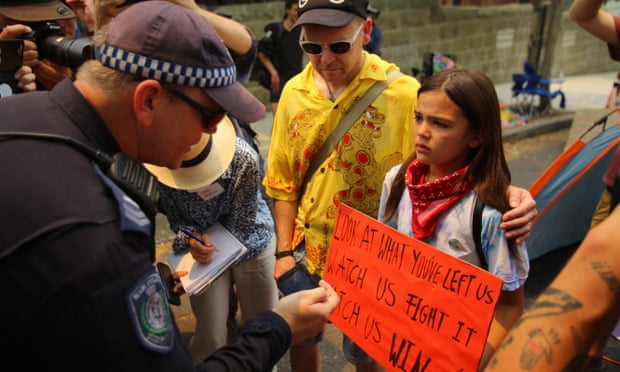
Outside the ‘Western’ world, screams of refusal have, however, long rasped the throats of peoples from indigenous groups, the Global South and the colonised world. For over five centuries of resistance, many of these communities have practically embodied the refusal to accept the unacceptable destruction of their socio-natures by capitalist, colonialist forces. Yet these screams – of those defending lands and environments in some of the planet’s most essential ecosystems – have long been ignored and violently silenced, with over 160 killings document in 2018 alone. In a similar (albeit far more subtle) expression of state violence, the recent image showing a crying 13-year old, Izzy Raj-Seppings (2019), being threatened with arrest for protesting Australian inaction, has helped capture this long state suppression of civil societies’ environmentalist scream in all its grotesqueness.
As this suggest though, not all is quiet on the Western front; growing demand for radical change is finding voice amongst civil society. Suppressed rage is beginning to rise. “How dare you!” screamed Greta Thunberg at world leaders recently, accusing them of stealing her childhood with their empty words and fairy tales of economic growth despite being amidst the sixth mass extinction. Screams are also beginning to mobilise in the shape of Extinction Rebellion and the School Strike 4 Climate, demanding answers to questions – such as that so eloquently expressed in the image below – in response to governments’ failings and lack of urgency within environmental governance.

However despite the rising noise, these failures were nevertheless so devastatingly-well epitomised in the recent deadlock at COP25 – the yearly (unsuccessful) UN climate talks. This yet again has reflected the continual capitulation of the state system to face and address the urgent and radical change needed. One commentator at COP25, Aruna Chandrasekhar, was left ruminating “is this really the best the world can manage?”, as she called for “enraged” protestors to “make sure they can hear us outside their closed doors”. In other words: we need to scream louder. This is for the future of a world screaming in fear at the loss of billions of being, screaming out for real radical change.
Jonathan Hyde, London

